
The Tale of the Woman and Death
(A Lore of the Boer’s Head Tale)
Written by P.H. Boer
There are some nights at the Boer’s Head when the fire burns lower than usual, not for lack of wood, but out of respect. The kind of nights when the stew thickens unbidden, and the candle flames lean slightly away from the hearth.
It was on such a night she arrived.
Rain clung to her like a second skin, her hair slicked down in ropes. She looked no older than twenty, but her eyes belonged to a much older storm. She didn’t speak. Just drifted to the armchair near the fire, the one no one ever chooses, and sat. That should have been the first sign.
I brought her the stew, of course. And black bread, warm from nowhere. She ate like a starved animal tasting memory. When other patrons left their bowls unfinished, unease written across their faces, she collected them without shame and consumed them, licking her fingers between mouthfuls.
This went on for thirteen nights. She never spoke. Never left. Just slept in her nest of rags and dishes and always, always sat in that same chair when the fire was lit.
And then, on the fourteenth night, he arrived.

Tall. Severe. Dressed like an ancient accountant who’d been buried with grudges. When he entered, the storm ceased its tantrum for a moment, like the world itself was holding its breath.
He stared at me for a long time. Tilted his head. Squinted.
There was something hollow behind his eyes, like he’d seen the punchline to the world’s final joke.
“You’re not the one I remember.”
Then he scanned the room, eyes landing on the girl in the fire chair. He turned back and, with a voice like dried paper, said…
“Tea. Three sugars. Splash of milk.”
I blinked.
I don’t serve tea.
I’ve never even stocked tea. Or sugar. Or milk for that matter.
But there it was, waiting beneath the counter. A small tin, with TEA on it’s front. It was warm to the touch. When I opened it, the scent rolled out like a funeral procession, rotting autumn leaves, distant thunder, and something older than mold.
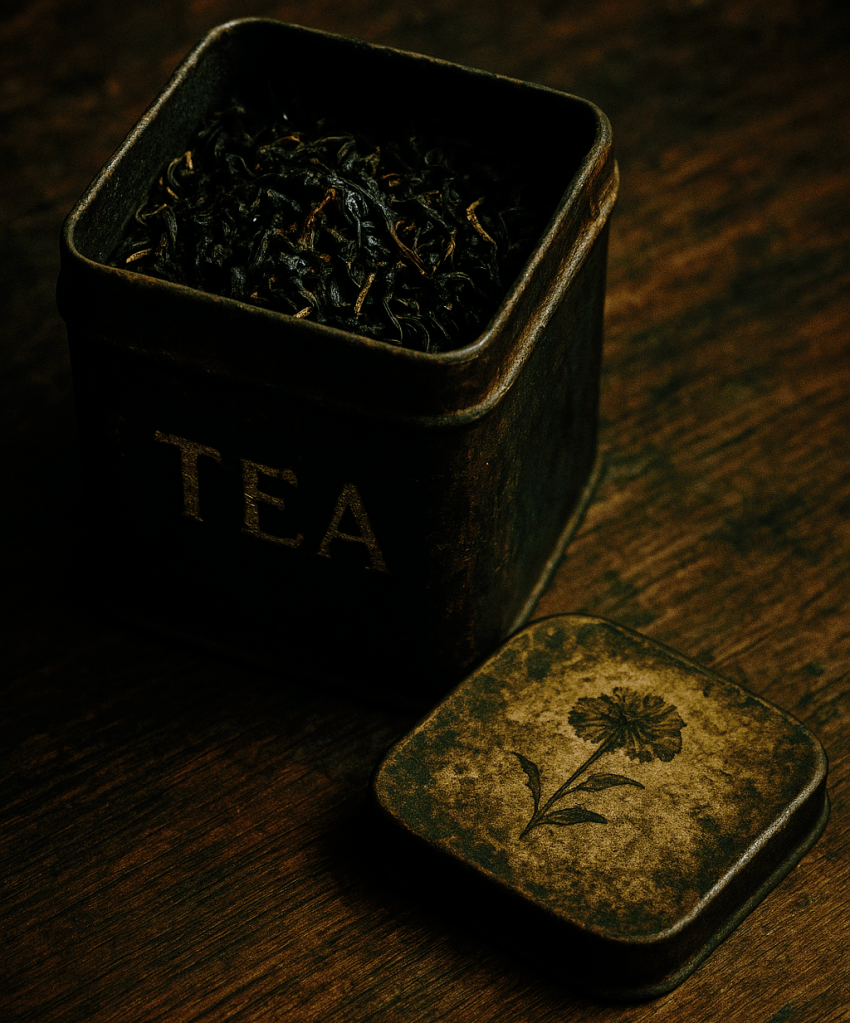

I brewed it without question.
He laid a hand on the girl’s shoulder. She looked up, eyes soft and already knowing. In that moment, I saw him clearly, not the man he’d chosen to appear as, but what he truly was. A skeleton wrapped in suggestion, kindness worn like borrowed clothing.
She stood. Left with him.
And when the door shut behind them, it opened again. He returned, alone.
“Tea,” he said, almost sheepishly. “If it’s still warm.”
He drank in silence. Then let out a small, satisfied sigh. “Mm. That’s good.”
I said nothing, but he must’ve felt me staring, because he cleared his throat with a sound like dry branches snapping in wind, then offered a polite nod.
He didn’t linger. Just placed the cup on the bar and looked at me for a moment too long. As if assessing damage. Or promise.
Then he turned, and was gone.
The tin remains. I’ve never touched it since.
Sometimes, when I lose track of time or find a page in the ledger I don’t recall writing, I think of him. When doors appear in places I’ve already dusted, or when patrons speak in languages I’ve never heard but understand anyway, I wonder.
I do not know if he is a regular.
But I clean a cup for him just the same.
And when things change here, shifts I don’t recall making, I assume he’s been by.
Not to visit.
To check in.
 Tales from the Boer’s Head